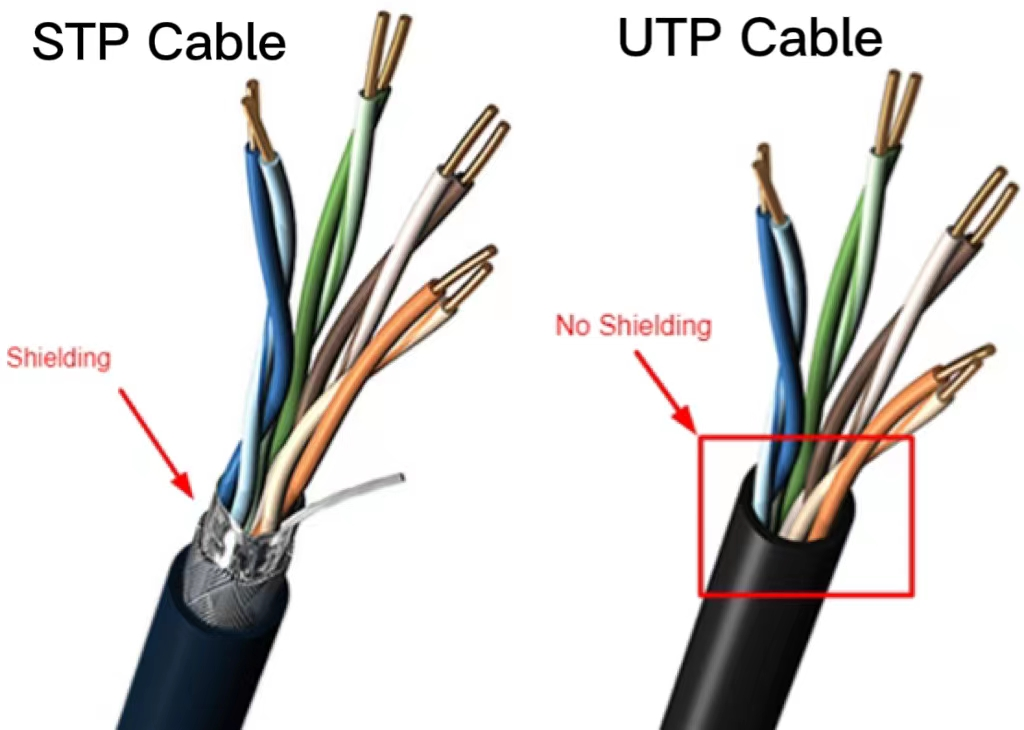
What is shielded cable and what makes it different
A shielded cable, also called Shielded Twisted Pair (STP), is a network cable where the copper wire pairs are wrapped in one or more metallic shielding layers in addition to the standard insulation and outer jacket. The shielding material is typically aluminium foil, braided copper mesh, or a combination of both depending on the cable type.
That metallic shield has one job: to block electromagnetic interference (EMI) and radio frequency interference (RFI) from getting in or out of the cable. It acts as a physical barrier, and when properly grounded, it acts as a Faraday cage around your signal, redirecting interference away before it can disrupt data transmission.
The twisted pairs inside a shielded cable still use the same twist-based interference reduction technique as unshielded cable. The shield is an additional layer of protection on top of that, not a replacement for it. This combination makes shielded cable the stronger choice in environments where electromagnetic noise is genuinely present.
Shielded cable (STP) is a type of twisted pair network cable that has a metallic foil or braided shield wrapped around the wire pairs to protect the signal from electromagnetic interference (EMI). It is used in industrial areas, data centers, hospitals, factories, and other locations where electrical noise is present.
What is unshielded cable and how it reduces interference without a shield
An unshielded cable, or Unshielded Twisted Pair (UTP), is a network cable where the wire pairs are twisted together but have no additional metallic shielding layer. The only protection against interference is the physical twist of the wire pairs themselves.
This works because of how electricity and electromagnetic fields behave around a twisted wire pair. Each wire in a pair carries the signal and its exact opposite (differential signaling). When outside interference affects both wires equally, the receiving equipment cancels the interference out because it only reads the difference between the two signals, not the absolute value of either one. Twisting the wires ensures that both wires in the pair are exposed to the same interference equally, making the cancellation effective.
This technique works very well in low to moderate interference environments. It is the reason UTP cable has been the global standard for office networking for over three decades. It is cheaper to produce, lighter, easier to route and terminate, and performs excellently in clean electrical environments like standard commercial offices.
The limitation appears when interference levels are high enough to affect the two wires unequally, or when the interference is intense enough to overwhelm the differential cancellation. At that point, signal quality degrades and you start seeing packet errors, slow network performance, and connectivity drops that are difficult to diagnose because they are intermittent rather than constant.
UTP relies on physics to cancel interference through twisted pair differential signaling. STP adds a physical metallic barrier to block interference before it even reaches the wires. Both work. STP works in more demanding environments.
How cable shielding actually works: the Faraday cage principle
The shielding in an STP cable works on the same principle as a Faraday cage. A Faraday cage is any conductive enclosure that blocks electromagnetic fields. When you wrap a metallic shield around a cable and ground it correctly, external electromagnetic fields induce a small current in the shield. That current then creates its own opposing electromagnetic field that cancels out the original interference. The result is that the signal inside the cable is protected from external noise.
For this to work correctly, the shield must be grounded. A floating shield, meaning one that is not connected to ground at one or both ends, can actually make interference worse by collecting and re-radiating it. This is one of the most important installation requirements for shielded cable and a common source of problems when shielded cable is installed without proper grounding discipline.
The shielding also works in reverse. It prevents the signal inside the cable from leaking outward as electromagnetic radiation. This is important in security-sensitive environments like government facilities, financial institutions, and data centers where signal containment is a requirement.
In UAE commercial and industrial buildings, ground quality varies. A proper earth bond must be confirmed before relying on shielded cable for EMI protection. If the ground connection is poor or missing, shielded cable does not provide its intended benefit and may perform worse than UTP in that environment.
Shielded vs unshielded cable: key differences at a glance
Before going into the detailed comparison table, here is a direct side-by-side view of how STP and UTP differ across the factors that matter most for a network cabling decision.
Shielded Cable (STP / F/UTP / S/FTP)
With metallic shielding layer
Unshielded Cable (UTP)
No metallic shielding layer
Shielded cable types: what the notation actually means
One of the most confusing parts of shielded cable is the naming convention. When a cable supplier or installer mentions F/UTP, S/FTP, or SF/UTP, these are ISO/IEC standard notations that describe exactly what shielding layers are present and where they are applied.
The notation reads as: [Overall shield] / [Individual pair shield]TP. The letters before the slash describe what wraps around all four pairs together. The letters after the slash describe what wraps around each individual pair. TP always stands for Twisted Pair.
The shielding materials are: U for unshielded (no layer), F for foil (thin aluminium or copper foil), and S for braided screen (woven copper mesh). Foil is thinner and lighter. Braided mesh is heavier and more durable but adds diameter and cost.
Foil over all pairs, no individual pair shield
Braided screen over all pairs, no individual pair shield
Foil overall plus foil around each individual pair
Braided screen overall plus foil around each individual pair
Braided screen plus foil overall, no individual pair shield
No shielding at all — standard unshielded twisted pair
UTP cable categories explained: Cat5e, Cat6, Cat6a, Cat7, Cat8
Both shielded and unshielded cables are available across multiple performance categories. The category defines the cable's rated frequency, maximum supported data speed, and whether the cable meets current standards for that speed at the standard 100-metre horizontal run distance.
| Category | Max frequency | Max data speed | Shielded version available | Best for | Status in Dubai |
|---|---|---|---|---|---|
| Cat5e | 100 MHz | 1 Gbps at 100m | Yes (F/UTP) | Basic Ethernet, VoIP, CCTV, small offices | Still installed — cost-effective for small setups |
| Cat6 | 250 MHz | 10 Gbps at 55m, 1 Gbps at 100m | Yes (F/UTP, S/UTP) | Standard office Ethernet, data cabling, most Dubai commercial builds | Most commonly installed — current Dubai standard |
| Cat6a | 500 MHz | 10 Gbps at 100m (full distance) | Yes (F/UTP, F/FTP, S/FTP) | Data centers, high-density offices, future-proofed buildings | Growing adoption — recommended for new builds |
| Cat7 | 600 MHz | 10 Gbps at 100m (shielded only) | Shielded only (F/FTP or S/FTP required) | Data centers, high-interference environments, enterprise backbones | Specialist use — data centers and enterprise sites |
| Cat8 | 2000 MHz | 25 Gbps or 40 Gbps at 30m | Shielded only (S/FTP) | Server room top-of-rack connections, short-run data center links | Specialist use — data centers, short distance high-speed |
Cat7 and Cat8 are shielded-only standards. There is no unshielded Cat7 or Cat8. If a supplier offers you unshielded Cat7 cable, it does not exist as a standard. Cat6a UTP is the highest unshielded category in the current TIA-568 and ISO 11801 standards. Cat7 requires F/FTP or S/FTP shielding to achieve its rated performance.
When to use shielded cable for structured cabling in Dubai
The decision to use shielded cable should be based on the actual electromagnetic environment of your site, not on a general preference for more protection. Shielded cable costs more, takes more time to install correctly, and delivers its benefits only when the installation is done properly. Use it where the environment genuinely requires it.
Environments in Dubai where shielded cable is the correct choice
When unshielded cable is the correct and preferred choice
Unshielded twisted pair cable is not the inferior option. It is the correct option for most standard commercial environments in Dubai, and choosing shielded cable for an office that does not need it adds unnecessary cost and installation complexity without providing any measurable benefit.
Full comparison table: shielded vs unshielded cable across all key factors
| Factor | Shielded Cable (STP / F/UTP / S/FTP) | Unshielded Cable (UTP) | Practical impact |
|---|---|---|---|
| EMI protection | Excellent — metallic shield blocks external interference before it reaches the signal wires | Moderate — relies on differential pair cancellation, works in low to moderate interference environments | Choose STP near industrial equipment, motors, elevators, and HVAC |
| Signal quality over distance | Maintains signal integrity better over longer runs in noisy environments | Meets standard at 100m in clean environments; degrades in high-EMI environments | STP more reliable for long runs in electrically demanding buildings |
| Crosstalk between pairs | Lower crosstalk — especially with F/FTP and S/FTP (individual pair shields) | Managed by twist rate — good up to Cat6 standards | F/FTP and S/FTP reduce alien crosstalk critical at 10 Gbps Cat6a and Cat7 |
| Physical size and weight | Larger diameter (typically 7–8mm vs 5–6mm for UTP), heavier per metre | Smaller diameter, lighter, easier to route in conduit and cable trays | UTP fits more runs in the same conduit size; important in dense cable trays |
| Installation flexibility | Less flexible — harder to bend in tight corners, especially with braided shielding | More flexible — bends easily, faster to route and terminate | UTP faster to install; STP requires more care at patch panels and outlets |
| Grounding requirement | Must be grounded at both ends — critical for the shield to work correctly | No grounding requirement | STP installation must include verified ground connections; a poor ground makes STP unreliable |
| Material cost | Higher — shielding material adds cost per metre | Lower — no shielding material | Cost difference is meaningful across 1,000+ metre installations typical in Dubai office builds |
| Installation labour cost | Higher — more time per termination, grounding work adds scope | Lower — faster termination, no grounding work | Both material and labour cost differences compound in large projects |
| Compatibility with standard hardware | Compatible with standard RJ45 equipment — shielded connectors should be used | Fully compatible with all standard RJ45 patch panels, switches, and outlets | STP requires shielded RJ45 connectors and shielded patch panels to preserve benefit end-to-end |
| Typical Dubai applications | Free zones, industrial areas, data centers, hospitals, broadcast facilities, secure buildings | Commercial offices, residential buildings, retail, education, hotels, SME offices | Use the right type for the environment — both are correct in their proper context |
| Standards | TIA-568, ISO 11801 — all categories Cat5e through Cat8 available in shielded versions | TIA-568, ISO 11801 — Cat5e through Cat6a in UTP. Cat7 and Cat8 require shielding | Cat7 and Cat8 are shielded-only by standard definition — no true unshielded version exists |
Grounding shielded cable correctly: why it matters and what happens when it is wrong
Grounding is the most critical and most frequently mishandled aspect of shielded cable installation. The shielding layer in an STP cable only works as intended when it is electrically connected to a stable ground reference. Here is what happens in both scenarios.
The shield is connected to the building ground at one end (single-ended grounding) or both ends (depending on the environment and grounding quality). External electromagnetic fields induce a small current in the shield. That induced current creates a cancelling electromagnetic field. The result is that the interference never reaches the signal conductors inside. The cable performs as designed.
The shield becomes a large antenna floating in the electromagnetic environment. Instead of cancelling interference, it collects it and redistributes it along the entire cable run. Network performance in this scenario can be worse than with UTP cable in the same environment. This is a common cause of unexplained network instability in buildings where someone installed shielded cable without proper grounding.
Grounding rules for shielded cable in structured cabling
In a standard structured cabling system, the shield must be grounded at the patch panel end of the cable run. The patch panel itself must be bonded to the equipment room ground bar (TGMB or TGBB as defined in TIA-607). Shielded keystones or outlets at the work area end are typically left floating or connected to the equipment chassis ground depending on the application.
Ground loops are a concern in large buildings where the ground potential differs between rooms or floors. A ground loop occurs when both ends of the shield are connected to grounds that are at slightly different potentials, causing current to flow through the shield continuously. This current generates its own EMI inside the cable. In these situations, single-end grounding at the patch panel is the standard approach.
Many older commercial buildings in Dubai and UAE free zones have variable ground quality. Before committing to shielded cable as your EMI solution, confirm that your building's ground is clean and properly bonded. A structured cabling survey from an experienced company should include a ground quality check before specifying STP across the installation.
How to decide: a step-by-step framework for your Dubai installation
Most businesses in Dubai overthink this decision in the wrong direction. They either default to unshielded everywhere without considering the environment, or they assume shielded is always better and spend more without justification. The correct approach is a structured assessment of the actual environment.
Identify your environment type
Is the building a standard commercial office, an industrial facility, a healthcare site, a data center, or a mixed-use building? The environment type determines the baseline interference level. Standard offices almost always suit UTP. Industrial, healthcare, and data center environments need STP assessed seriously.
Map your cable routing paths
Walk the planned cable routes and identify what the cables will pass near. Elevator shafts, HVAC plant rooms, generator rooms, UPS systems, transformer rooms, and industrial machinery are all sources of EMI. Any cable run passing within 300mm of these should be assessed for shielded cable.
Check ground quality in your building
Before specifying STP, confirm that your building has a clean, properly bonded ground system. A floating or poor-quality ground makes shielded cable unreliable. If ground quality cannot be confirmed or improved, a correctly installed UTP system may outperform an improperly grounded STP system.
Determine your performance requirements
What data speeds does your network need now and in the next 5 to 10 years? Cat6 UTP handles 1 Gbps at full 100m runs. Cat6a handles 10 Gbps at full 100m in both UTP and shielded versions. Cat7 and Cat8 are shielded only. If you need 10 Gbps at full horizontal run distances, Cat6a is your baseline choice regardless of environment.
Consider a mixed specification
Most real buildings are not uniformly high-EMI or uniformly clean. A pragmatic and cost-effective approach is to use shielded cable for runs near interference sources and unshielded cable for the rest of the building. This requires identifying the specific high-risk runs during the design phase and specifying accordingly rather than applying one type building-wide.
Get a site survey before finalising the specification
Al Hutaib's structured cabling team conducts site surveys for Dubai and UAE businesses before issuing a cable specification. A proper survey identifies interference sources, maps routing paths, confirms ground quality, and produces a cable schedule that specifies shielded and unshielded sections based on the actual environment rather than a blanket assumption.
Common mistakes businesses make when choosing between shielded and unshielded cable
Assuming shielded cable is always better
This is the most expensive mistake. In a clean office environment with properly separated cable runs, shielded cable provides no measurable performance advantage over Cat6 UTP while costing significantly more to supply and install. Every dirham spent on unnecessary shielding is money that could go toward better network hardware, higher density access points, or future-proofing with Cat6a instead.
Installing shielded cable without grounding it
This produces the worst possible outcome. An ungrounded STP cable in a high-EMI environment performs worse than UTP and costs more to install. If your specification calls for shielded cable, the installation must include verified ground connections at every patch panel and equipment rack. This is not optional and should be tested and documented as part of cabling commissioning.
Mixing shielded and unshielded components
Using shielded cable but terminating it on unshielded patch panels and outlets breaks the shielding continuity. The EMI protection only works when the shield is continuous from one end of the run to the other, including the connectors at both ends. Using shielded cable with unshielded RJ45 connectors eliminates most of the shielding benefit at exactly the most interference-vulnerable points: the terminations.
Defaulting to UTP in clearly industrial environments without assessment
Some installers in Dubai routinely specify Cat6 UTP for all projects regardless of environment to keep costs down or simplify procurement. In a factory or industrial warehouse, this results in intermittent connectivity problems that are extremely difficult to diagnose because the EMI sources are not constant. The symptoms appear as random slowness, packet loss, or connectivity drops that only happen when specific machinery is running nearby.
Forgetting to spec the cable type for individual high-risk runs in otherwise clean buildings
A standard office building may have one run that passes through an electrical riser or alongside a large HVAC system. Specifying UTP everywhere and then wondering why that particular run has problems is avoidable. During design, every cable run should be reviewed for proximity to potential EMI sources and flagged if shielded cable is appropriate for that specific route.
Frequently asked questions about shielded and unshielded cable
What is the difference between shielded and unshielded cable
Shielded cable (STP) has one or more metallic layers wrapped around the twisted wire pairs, providing physical protection against electromagnetic interference (EMI). Unshielded cable (UTP) relies on the twist of the wire pairs alone to cancel out interference with no metallic shielding layer. STP is heavier, more expensive, and requires grounding. UTP is lighter, cheaper, easier to install, and suitable for most offices. The right choice depends on the electromagnetic environment of your installation site.
Is Cat6 shielded or unshielded
Cat6 is available in both shielded and unshielded versions. The standard Cat6 UTP (U/UTP) is the most commonly installed version for office networks in Dubai and worldwide. Cat6 F/UTP and Cat6 S/UTP are shielded versions used in environments with electromagnetic interference. Cat6a is also available in both UTP and shielded (F/UTP, F/FTP) versions. Cat7 and Cat8, however, are shielded-only standards.
Does shielded cable need grounding
Yes, absolutely. Shielded cable must be properly grounded to work correctly. The metallic shield only provides EMI protection when it is connected to a stable ground reference. An ungrounded shielded cable collects electromagnetic interference and redistributes it along the cable run, often making performance worse than an unshielded cable in the same environment. In a structured cabling installation, the shield is typically grounded at the patch panel end via a shielded patch panel bonded to the building ground bar.
What does STP and UTP mean in network cables
STP stands for Shielded Twisted Pair. UTP stands for Unshielded Twisted Pair. Both types use copper wire pairs twisted together. STP adds one or more metallic shielding layers for EMI protection. UTP has no additional shielding. The current ISO standard notation describes shielding more precisely — for example, F/UTP means foil around all pairs (no individual shielding), and S/FTP means braided screen around all pairs plus individual foil around each pair.
Which cable is better for a Dubai office — shielded or unshielded
For most standard commercial offices in Dubai, Cat6 UTP is the correct choice. It delivers excellent performance, is well established, and is more cost-effective than shielded alternatives. Shielded cable adds value in offices inside industrial buildings, near elevator shafts or HVAC plant, or in buildings with high electrical activity. A site survey confirms which approach is appropriate. Al Hutaib recommends a structured cabling assessment before finalising the cable specification for any Dubai office project.
What are the types of shielded cable available
The main types are: F/UTP (foil around all pairs together, most common), S/UTP (braided screen around all pairs), SF/UTP (braided and foil around all pairs), F/FTP (foil around each individual pair plus foil around all pairs — used in Cat7), and S/FTP (braided screen around all pairs plus foil around each individual pair — highest protection, used in Cat7 and Cat8 for data centers and secure environments). The right type depends on the interference level and performance requirements of your installation.
Can shielded cable be used with standard RJ45 connectors
Technically yes, but the shielding benefit is largely lost at the connection point. To maintain shielding continuity, shielded cable should be terminated with shielded RJ45 connectors (also called STP plugs or keystones), shielded patch panels, and shielded face plates at work area outlets. Using shielded cable with unshielded components breaks the shield continuity at the most vulnerable points of the run. If the full system is not shielded end to end, the cable shielding may not provide the expected protection.
How do I know if I need shielded cable for my Dubai building
The most reliable way is a structured cabling site survey. The survey assesses your cable routing paths, proximity to interference sources like motors, generators, and HVAC systems, your ground quality, and your performance requirements. Al Hutaib conducts site surveys for structured cabling projects across Dubai and UAE. Contact our team by WhatsApp or phone to arrange an assessment before your cabling specification is finalised.
- Structured cabling installation services in Dubai
- Top structured cabling brands in Dubai — D-Link, Belden, Opterna, Schneider
- Why structured cabling is essential for Dubai businesses
- Structured cabling and data security best practices in Dubai
- Network maintenance AMC for Dubai businesses
- IT AMC contracts in Dubai